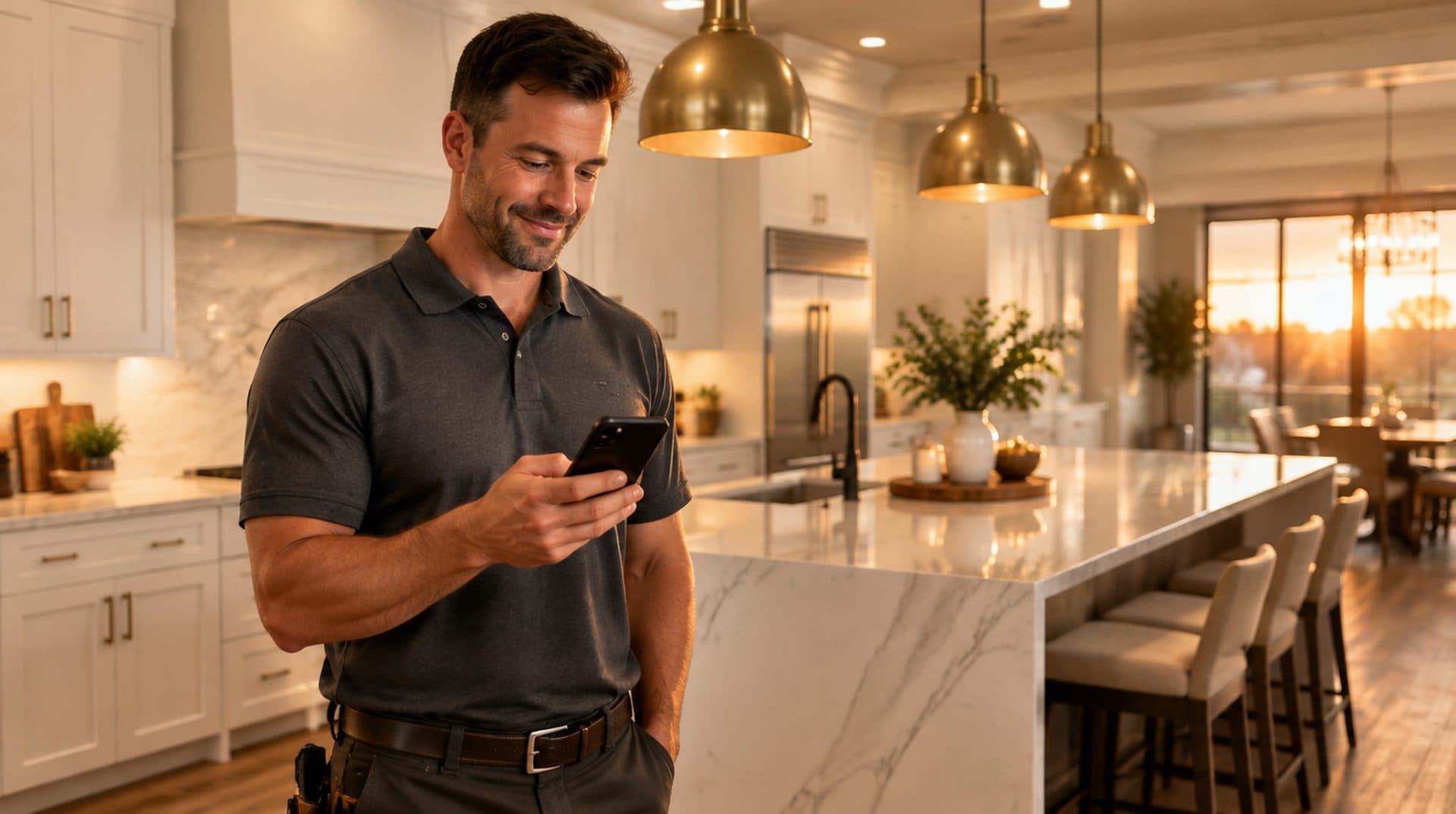
Stop Selling the Remodel. Sell the Kitchen Party.
Nobody ever hired a contractor because of quartz countertops. They hired one because they were embarrassed to have people over. Here's why your ads should sell the feeling, not the features — and how that shift changes your cost per lead.
Open any contractor's Facebook ad and you'll see the same thing: a close-up of a cabinet, a list of materials, and copy that reads like a supply house invoice. "Custom shaker cabinets. Quartz countertops. Licensed and insured."
Here's the uncomfortable truth: nobody ever hired a contractor because of quartz countertops.
They hired one because they were embarrassed to have people over. Because the kitchen they'd been apologizing for was finally going to be the one everyone gathered in. The countertop was never the product. The feeling was.
Features Don't Make People Call. Feelings Do.
This isn't marketing theory — it's how the buying decision actually works for high-ticket home services. A kitchen remodel is a $15,000–$40,000 purchase. Nobody spends that kind of money because a cabinet door looks nice in a photo. They spend it because something in their daily life bothers them enough to fix it.
Think about what a homeowner is actually thinking when they fill out your form: "I'm tired of being embarrassed when people come over." "I want the house my kids remember growing up in." "My mother-in-law is visiting for Christmas and I can't do another year like this."
None of those thoughts contain the word "quartz." Every one of them is worth $25,000 to the contractor who speaks to it.
Meanwhile, the ad they're actually seeing says "10% off cabinet refacing this month." You're answering a question they never asked.
Why Feature Ads Lose (The Math)
This isn't just about feelings — it shows up in the numbers. Feature-based creative has two structural problems.
First, it all looks the same. Every remodeler in a 30-mile radius is running some version of "beautiful kitchens, quality craftsmanship, free estimates." When ten ads say the same thing, the homeowner picks on price — and now you're competing on discounts instead of desire.
Second, features don't create urgency. "Quartz countertops" is a nice-to-have. "Hosting Thanksgiving without apologizing for your kitchen" has a deadline. Ads tied to a moment, a season, or an embarrassment convert faster because the pain is already scheduled.
When the ad speaks to what the homeowner is actually feeling, click-through goes up and cost per lead comes down — because you're no longer one of ten identical cabinet photos.
The Thanksgiving Test
Here's the practical filter. Before any ad goes live, run it through this question: could this ad be for any contractor in America?
If yes, rewrite it.
"Custom kitchens built to last" — could be anyone. "The kitchen your family actually gathers in" — that's a specific feeling, and it only works if you mean it.
A few before-and-after examples. Before: "Bathroom remodels starting at $12,000. Free estimates." After: "The bathroom you don't have to explain to guests anymore." Before: "Quality flooring installation. Licensed and insured." After: "Floors your kids can actually play on." Before: "We build beautiful outdoor living spaces." After: "Summer nights you don't want to end."
Notice what's missing from the "after" versions: materials, prices, credentials. Notice what's in them: a scene the homeowner can already picture themselves in. You're not asking them to evaluate your work. You're letting them feel what it's like to already have it.
But Don't I Need to Show My Work?
Yes — just not in the ad. The ad's job is to make someone stop scrolling and feel something. Your website, your reviews, your portfolio — that's where the proof lives. The ad opens the door; the rest of the funnel closes it.
This is where most contractors get it backwards. They try to make the ad do the selling, so they cram in every credential, every material, every reason to trust them. The ad gets crowded, the feeling disappears, and it performs like every other ad. Let each piece do its job: the ad creates desire, the landing page builds trust, the estimate closes the deal.
How to Actually Film This
You don't need a production crew. The highest-performing creative we've seen for trades is shot on a phone, and it's almost embarrassingly simple. First, film the life, not the work. A family cooking together in the finished kitchen beats a slow pan across cabinets every time. If the homeowner will let you, get 15 seconds of them actually using the space. Second, start with the feeling, end with the proof. Open on the moment — the dinner party, the kids running in — then cut to a quick shot of the craftsmanship. Desire first, credibility second. Third, let the homeowner talk. A 20-second clip of a real customer saying "we finally had everyone over for the holidays" will outperform any scripted voiceover. It doesn't need to be polished. It needs to be real.
The bar isn't Hollywood. The bar is "does this feel like something I want." A shaky phone video of a happy family in a kitchen you built clears that bar. A studio-perfect cabinet close-up doesn't.
Key takeaway: your ads aren't competing on craftsmanship — every contractor claims that. They're competing on who makes the homeowner feel the result first. Sell the kitchen party, not the remodel. The contractors who get this don't need to discount. They're the only ones selling what the homeowner actually wants to buy.